Look up

I took this photo on an everyday walk in my neighborhood, April 2023.
“A good name for God is: “Not me.” Emerson said that the happiest person on Earth is the one who learns from nature the lessons of worship. So go outside a lot and look up.” — Anne Lamott
This is another new post. No time to write much, but I wanted to share this quote from that perennial source of quotable thoughts, Anne Lamott. I’m about to head outside for the walk that has become an essential part of every day for me. Those particular trees aren’t in bloom by May, but there will be other lovely things to see, including the Potomac River just a half mile away.
When looking for a photo to feature with today’s post, there were many shots I could have shared from all over the world. But it seemed most appropriate to share one from just a short distance from my own front door. You have many such sights outside your own home, different in detail but alike in the lessons we learn from getting outside. So I hope we’ll all heed Lamott’s advice, including the most crucial part of it: look up.
The whole world, 2017

As far as I know, this is the only photo of Mama with me as a baby, taken early 1957.
“If the whole world were put into one scale, and my mother in the other, the whole world would kick the beam.” — Henry Bickersteth, Lord Langdale
(2024 update: this is the 2017 revision of a post that will had appeared here twice before. I hope the text is as timeless as my enduring gratitude for the world’s most singular mother.)
Hello friends,
Thank you so much for your kind and encouraging comments. I have appreciated each one, and will respond as soon as I am able.
I wrote the post below for Mother’s Day four years ago, and I now re-post it in memory of my amazing Mama, who died yesterday. She lived only 20 months without Daddy, the love of her life, her husband of 66 years, and (during his final years) her constant caretaker. The relatively short time she lived without him was filled with suffering and heartbreak for her, but she held fast to her determined faith and indomitable spirit. Again and again, she expressed gratitude for the abundant blessings of her life, and reminded me continually that even in loss, we have reasons to give thanks. Up to the evening before Jeff’s passing, and well beyond that, she filled my life with her strength, courage, and refusal to give in to despair.

Seth, Mama, Jeff, Matt and me on September 13, 2016.
Ten days later, Jeff entered the hospital, never to return home again.
Jeff and my mother were so alike that losing her so soon after Jeff’s death resonates with the deep sadness that an abandoned child must feel. Now I carry on without the three steadfast and stalwart pillars of my life: Daddy, Mama, Jeff. No other person will ever love me as they did. None can equal their devotion, faith and diligence. No light will shine more brightly than that of their shared legacy, which marks the way ahead for me. Thanks for being with me through all this, and for caring!
The following post was first published on May 12, 2013:
Even after I became a mother, I have never liked Mother’s Day. It seems to me an artificially contrived and ultimately inadequate invention designed primarily to sell cards and flowers, and in some cases, to assuage an adult child’s guilty conscience. Nonetheless, I do find myself thinking of my own mother each year on this day, and feeling at a loss for words to describe what her presence has meant in my life.
Perhaps I dislike Mother’s Day mostly because none of the sentimental, flowery tributes commonly sold at this time of year ever seemed an appropriate homage to my mother, who was and is a formidable woman. Her blunt practicality and unfailing generosity are equal to her iron will and undaunted courage in the face of adversity. She has never been the longsuffering, quiet, kind and gentle saint portrayed by so many of the maudlin descriptions of motherhood. More than anyone I know, she embodies the truth that tough love is, in many cases, the most beneficial sort.
Yet just when she seems most intimidating, a whimsical humor will break through and leave us laughing. She is still the one I run to when hit with unexpected sorrow or hardship. Somehow, nothing seems quite as impossible after I’ve talked to Mom about it. She’s been through more than most of us can imagine, but always managed to outpace almost anyone I knew.
She survived poverty and polio as a very young child, and has lived almost her entire life with only one “good” leg, but she never allowed that to slow her down. She had four children in four different states within a period of ten years, my father’s career having demanded frequent moves. When she was nearly killed by a drunk driver going 70 mph who rammed into the driver’s door of her car, no one knew if she could ever fully recover, but she soon was back to her unrelentingly busy schedule, caring for her children and working on various church and community efforts.
Years later, when she faced brain surgery for a hemorrhaging aneurysm shortly before our wedding in 1980, she stayed true to form, stoic in the knowledge that she might not survive. Showing no fear and little emotion of any kind, she reminded us that no matter what happened, we all should feel grateful that she had lived through the car crash and was able to care for us until we were all grown. For as long as I can remember, she has given us a nearly flawless example of what it means to live in faith and trust that God will do what is best. I know that example will be with me always.
So, with all due respect to those who celebrate this day, to the preachers who will preach their yearly sermon about mothers, and the restaurants that will be filled to overflowing, and the many fitting tributes of love and appreciation that will be shown today, let’s all admit that no day could ever be long enough, no tribute strong enough, to capture the gratitude so many of us feel for the amazing gifts our mothers have given us. Happy Mother’s Day to all!
This post was first published seven years ago. The original post, comments and photo are linked, along with two other related posts, below. These links to related posts, and their thumbnail photos, do not appear in the blog feed; they are only visible when viewing the individual posts by clicking on each one. I have no idea why, nor do I know how they choose the related posts. That’s just the way WordPress does things.
Two parents who love

Energetic, eccentric and exceptional: Mama and Daddy with their first grandchild, 1977
“If you have two parents who love you? You have won life’s Lotto.” — Augusten Burroughs
As promised (or perhaps I should say threatened) I am posting something entirely new, though its theme has been found at this site again and again. I am approaching the seventh anniversary of my Mama’s death, so I decided to indulge myself by posting a poem I wrote as a sort of tribute to my parents. During Hilary Term of 2021, in my second online poetry workshop I took at Oxford during the Covid shutdown, our first assignment was to write a poem about food. Not being much of a cook, I decided to think of my mother, who was a skilled and highly praised cook despite having almost none of the gadgets and appliances today’s chefs enjoy.
The delightful thing about writing poetry is that it often takes one in an unexpected direction. That’s what happened here. But I was happy to capture a bit of my Mama’s forward thinking about organic food, cooking, gardening and nutrition, and also my Daddy’s skill as an archer.
Pioneers
Coffee grounds, banana peels and eggshells
were never thrown away in our fine home
but saved in a large saucepan on the counter.
Across the back lawn past the swimming pool
our Mama’s compost heap had to be fed
according to her strict organic rule.
What others discard was reborn for us
in produce gathered fresh, served hours later,
bread baked from grain unrefined as Mama’s blunt ways.
Daddy harvested venison with his primitive bow
and none of this was stylish in those days. Friends laughed
and so did we, but savored pride that did not show.
Thus were we fed, and thus we grew
strong as oxen, rich as any king.
Fourscore and seven years they lived
and cooked this way until our Daddy died.
And we, despite ourselves, craved humble food
baked skillet cornbread, gathered greens, and cried.
Too much rain

An unknown artist left this painting for us to appreciate.
Public doman, from Düsseldorfer Auktionshaus via Wikimedia Commons
If anyone asks you how I am
Just say I’m doin’ fine.
If you will do that for me,
I’ll do the same for you sometime.
And if anyone asks you where I’ve gone
Just say I’m down the line.
I don’t want my friends to see me like this.
Maybe some other time.
Too much rain fallin’.
Too much rain fallin’.
There’s just been too much rain, down on me.
One day I’m gonna understand
The way that my heart works,
And then I’m gonna work it out,
So that I won’t get hurt.
But if anyone asks you where I’ve gone,
Oh, don’t say where I am,
Just say you saw me and I’m doin’ fine,
‘Cause I’m doin’ the best I can.
Too much rain fallin’.
Too much rain fallin’.
There’s just been too much rain fallin’, down on me. — Carole King
Hello friends,
For some time now, I’ve wondered what to do about this blog. Since Jeff died, it has been very difficult to keep it going. I have never really been able to rest enough to recover from the grief, and the exhaustion of endless tedious paperwork, hard decisions, and bad news that seems never to stop coming. From where I sit now, watching how things have unfolded the past seven months, I can see no reason to think that anything is going to get easier anytime soon. Caring for a disabled adult son with Jeff’s steady and reliable help was difficult enough. All by myself, at age 60, and after 32 years of the continual, relentless pressure of being on call 24/7, it’s often more than I can manage.
Yet I live my everyday life in nearly total isolation, mainly seeing or talking only to people with whom I must stay in touch for managing Matt’s medical care and ongoing life issues. The comments on this blog are often the closest thing to conversation I have during the day. Sad, isn’t it? But I would be less than honest if I didn’t admit that. I say it only to let you all know how much your presence here has meant to me.
Some of you who stay in touch with me outside this blog know about the sorrow and grief that seems to just keep piling up, though it’s likely that no one person knows about all of it. That is as it should be, for only Jeff was in a position to understand all of it, and talking about it only makes it worse.
So now, for the first time in four and a half years, I must step aside from posting until I can replenish the wells of optimism and faith and hope and courage that are rapidly running dry. I will post here whenever I can, but I cannot say when or how often that will be. Please continue to pray for me, and know that I will read and respond to any comments you send.
One neglected pleasure I hope to make time for during this sabbatical is visiting the blogs many of you publish online. I am well aware of how much time, effort and sharing goes into blogging. There is so much inspiring, uplifting, candid, funny or thought-provoking richness out in the blogosphere. Of course, as I write this, I hear that nagging voice in my head saying “Ah, but that was what you intended to do when you dropped from blogging daily to blogging only twice per week– and didn’t that end up the way most of your good intentions do?” Guilty as charged. However, I won’t let past failures deter me from trying again.
It has been an amazing journey so far. Together we have compiled an archive of over 980 posts and countless online conversations, and if I’m unable to post very often, please remember there is a handy search feature which you can use to seek out posts on any topic you may want to read about. Comments remain open on every single post, so feel free to share your thoughts with me on any post you read, or re-read, no matter how old it may be.
Given the enormous life challenges so many of us have faced during the past five years, the abundance of thoughts, ideas, smiles, laughter, prayers and tears we have shared here (with each other and with all the world) represent no small accomplishment. Thanks for being part of it. I hope someday to get to that 1000-post milestone! Until then, know that you have been, and still are, an essential part of my personal and ongoing efforts to defeat despair.
This post was first published seven years ago. The rest, as they say, is history. I did manage to continue the blog, although missing the regular schedule here and there. And I’m still here, re-posting the more than 1100 posts I wrote over the years. But this month (and maybe next?) there’s not much to draw on. I’m going to TRY to fill in with some new posts here and there, even if only a quote and a photograph. Meanwhile, I appreciate your continued presence here, and your patience (especially with my tardy responses to your comments) now, as I have from the beginning.
The original post, comments and photo are linked, along with two other related posts, below. These links to related posts, and their thumbnail photos, do not appear in the blog feed; they are only visible when viewing the individual posts by clicking on each one. I have no idea why, nor do I know how they choose the related posts. That’s just the way WordPress does things.
The color green

The lovely garden of the Canadian Pavilion at EPCOT Center, August 2003
“When I look out the window, I exhale a prayer of thanks for the color green…for the simple acts of faith like planting a garden that helped see us through another spring, another summer.” — Barbara Kingsolver
Many times over the years I have felt deep gratitude for the color green, especially as it reappears each spring, brightening lawns and gardens, or in the heat of late summer when it provides cool shade above and soft relief from too-hot pavement underfoot. I love all the colors; it would be almost impossible to pick only one favorite. But I truly cannot imagine living without the green of the outdoors. Even in fall and winter, I look for the evergreen trees that accent the golden autumn foliage, or adorn an otherwise barren landscape.
If you’re feeling especially agitated or frustrated, or tired and discouraged, try giving yourself a tiny gift of grace: take a brief interval to focus on the many shades of green with which nature paints this season. Make a few minutes to step outside, if time and weather permit; if not, looking through a window (or at colorful garden magazines) will suffice. It almost always helps me. I hope it will do the same for you!
This post was first published seven years ago. The original post, comments and photo are linked, along with two other related posts, below. These links to related posts, and their thumbnail photos, do not appear in the blog feed; they are only visible when viewing the individual posts by clicking on each one. I have no idea why, nor do I know how they choose the related posts. That’s just the way WordPress does things.
The imaginary friend

Imagination to reality: meeting (again) in person, the smiles say it all.
Laurie, Matt, me, Kelly and Alys at Rustico’s in Old Town Alexandria, April 2017
“Writing is a job, a talent, but it’s also the place to go in your head. It is the imaginary friend you drink your tea with in the afternoon.” ― Ann Patchett
I think most everyone who writes can identify with this quote. But for those of us who blog, the line takes on a magnificent blur as the imaginary friend we reach through our writing may, from time to time, step through the mist and become real to us. And for many of us, this might happen again and again, with several different people who read our words, and whose words we read, leaving us with an entire family of friends we might never meet face to face.
Just last week I was exchanging emails with a woman in a distant city whom I know only through this blog. Though she does not blog herself, nor comment very often, she writes to me privately and has sent me several precious tokens of friendship in past years. I was able to tell her in all honesty that, though we had never met, I thought of her as a true friend.
Of course, sometimes we do meet in “real life,” which is a unique and exciting kind of joy. And sometimes the friendships we maintain through writing are the continuation of ties we formed in person when we lived in geographic proximity to each other long ago. But regardless of these details, once the friendship is formed, it flourishes through correspondence as surely as it would in person. As with handwritten letters, online correspondence that leads to friendship cannot be rushed. Instagram and Twitter are fun and sometimes useful, but they can’t connect us to another person deeply with only random soundbites and snapshots. But through emails or blogging, unconfined by a limited number of characters, and set free from geographic borders and boundaries, we can transform the imaginary friends into real ones.
That’s not exactly what Patchett meant, of course; she is referring to the writing itself– the process– becoming the imaginary friend. And I don’t disagree that can happen. But how dimensional and vibrant it becomes, when that imaginary friend of writing introduces us to all sorts of fascinating people who also love to read, and write, and visit, through this historic form of communication that has remained vital from the age of quill pens right up to the era of digitally “instant” contact.
So I invite you to join me at the imaginary tea party that is always going here, or as Sheila and I might say, at various Club Verandah locations all over the world. We can chat and have lots of fun even if we never meet face to face. And if we ever do meet, it will be even more festive and magical.
This post was first published seven years ago. As many of you know, Patchett’s quote has taken on an entirely different dimension since I began formally studying writing at Oxford, where some of the friendships are formed in online cohorts, some in face-to-face classes, and some (delightfully!) include both, as summer brings us together from all over the world. Though I’m not writing new posts here as often as I’d hoped I would, I am definitely writing more than I ever have, and it remains the deep joy it has been for decades.
The original post, comments and photo are linked, along with two other related posts, below. These links to related posts, and their thumbnail photos, do not appear in the blog feed; they are only visible when viewing the individual posts by clicking on each one. I have no idea why, nor do I know how they choose the related posts. That’s just the way WordPress does things.
You won’t be the same

On April 3, 2004, this supercell thunderstorm dropped 2″ diameter hail over Chaparral, N.M. causing widespread damage. Even so, the sun broke through those formidable clouds.
Photo by Greg Lundeen, public domain via Wikimedia Commons.
“And once the storm is over, you won’t remember how you made it through, how you managed to survive. You won’t even be sure, in fact, whether the storm is really over. But one thing is certain. When you come out of the storm, you won’t be the same person who walked in. That’s what this storm’s all about.” ― Haruki Murakami
There’s an old saying that what doesn’t kill you will make you stronger. I’ve never been particularly fond of that quote, and to this day I’m not sure I believe it. Speaking strictly for myself, I feel weaker than I’ve ever felt. But if that old saying is true, and if I survive the past five years with my sanity intact, surely I will be a female Hercules.
Until this most recent storm is resolved, it’s probably best not to discuss it here. Let’s just say that there is very little chance that Matt and I can hold onto even what currently remains of our life as it once was. Change– seismic, inevitable change– seems to be hitting us with overpowering force. Stay tuned and I’ll keep you updated. For now, though, please accept my deepest gratitude for being with us through all this. And please keep those prayers coming!
If you are facing unwanted changes right now, I hope you will grit your teeth and hang on. And if you are not, just wait awhile; sooner or later, it hits all of us. Let’s be strong for each other and keep believing that despair can be defeated, and one day it will be. For good.
For those who may be interested, the full video of Jeff’s burial ceremony
is available for viewing online at this link.
This post was first re-published seven years ago today. Reading over it, I am stunned at the thought of how much grief and trauma still lay ahead for me on pretty much a continual basis in the coming years, even when I thought things could not be much worse. For me, the storm was certainly NOT over. And I’m starting to think it really never will be. It’s a blessing we don’t know what the future holds, and I’m afraid even to think of it. But my survival amazes me now even more than it did then. I keep putting one foot in front of the other and hoping that the worst is behind Matthew and me. But I try not to think too much about it either way.
The link to Jeff’s funeral video is still active. There’s a nice intro that lasts less than a minute, in case you want to watch it but don’t have much time.
The original post, comments and photo are linked, along with two other related posts, below. These links to related posts, and their thumbnail photos, do not appear in the blog feed; they are only visible when viewing the individual posts by clicking on each one. I have no idea why, nor do I know how they choose the related posts. That’s just the way WordPress does things.
Spring always finds a way

There’s still this: our York back yard, April 14, 2017
“…spring always finds a way to turn even the coldest winter into a field of green and flowers and new life.” — Charlotte Eriksson
Probably there are few spots of ground in this hemisphere that have been more neglected in the past three years than our once-lovely azalea garden in the corner of our York back yard. When we first planted additional azaleas back there over twelve years ago, we tended it lovingly. I pruned the shrubs and Jeff was careful to feed and mulch the plants with the acidic nourishment they preferred. Once he even gathered a big bunch of pine straw from the wooded common areas of our neighborhood because I told him that azaleas loved pine straw (or so my mother always told me).
But somewhere along the way, our springtime gardening got hijacked. Spring 2013 brought Jeff’s first liver surgery; Spring 2014, Matt’s fifth open heart surgery; Spring 2015, work crews and equipment were in our yard continually as our guest house was being built; Spring 2016, Jeff’s brain tumor and craniotomy, and of course, Spring 2017, his burial. That corner of our yard is now overgrown so wildly that I can barely walk through to the fence where Pasha is buried near the large tree. I wasn’t expecting much beauty to show up there this spring.
Lo and behold, though, that little patch of ground is doing fine all on its own. Two days ago I looked out the kitchen window and saw the sun streaming through the dogwood flowers, and had to run get the camera to take a shot to share with you.
Don’t you just love it when things go fine even when you aren’t able to contribute to the effort? This has been another week filled with bad news, but springtime always has something uplifting to say to me. I hope you’re enjoying some seasonal cheer, too!
This post was first re-published seven years ago today. Of the tens of thousands of photos I’ve taken over the years, the ones of this spot in our York back yard will always be among my favorites. There’s still a touch of sadness that the home we loved so well did not become a place where we would enjoy our plans for shared retirement. But I’m comforted that another family will be enjoying the beauty, and grateful for the 17 years I had there.
The original post, comments and photo are linked, along with two other related posts, below. These links to related posts, and their thumbnail photos, do not appear in the blog feed; they are only visible when viewing the individual posts by clicking on each one. I have no idea why, nor do I know how they choose the related posts. That’s just the way WordPress does things.
A sunny spirit

Matt and Drew in 1986, laughing together as they still do so often.
“Humor is the great thing, the saving thing. The minute it crops up, all our irritation and resentments slip away, and a sunny spirit takes their place.” — Mark Twain
Of all the things that have helped us survive the past thirty years, and even before that, I would have to say that humor is near the top of the list. I cannot count the times when a good laugh has lightened everything up for us. If someone asked me to name the trait I value most in both our sons, it might well be their robust sense of humor.
Years ago when the boys and I were visiting my parents, we decided to take the MARTA train into Atlanta for some reason or other. I have forgotten what we did in town that day; what I remember most is something memorable that happened on the way home.
It was right around rush hour in the afternoon, and our train was crowded. Somewhere between West End and College Park, after the train had gone above ground but was not near a station, it began to slow, grinding to a stop seemingly in the middle of nowhere.
For a couple of seconds a hush fell over our car, and then something wonderful happened. As if on cue, almost everyone in the car burst into laughter. It was so contagious, it was hard not to join in. As we sat there — I don’t remember how long, but it might have been ten or twenty minutes — there was a relaxed, almost party atmosphere as people engaged in lively speculation about what was going on, and how long it might be before it was fixed.
What surprised me most was the complete absence of any impatience, irritation or annoyance from anyone I heard. It was as if we were all caught as extras in some sitcom episode or comedy movie, enjoying it to the hilt. It was most unexpected, and makes me smile to this day when I think about it. The car eventually started up again, but the memory of that temporary stop lingers on.
I’ve wondered about it a good bit over the years. Why did these people react with such spirited humor? I tell myself that maybe it was something about the relaxed good will of Atlanta (I can’t imagine that happening on the New York subway) or the southern African-American culture (we were the only white people in our car) or maybe it was just the sunny weather of a beautiful day in a lovely city.
Whatever the reason, the experience left me indelibly impressed with the power of humor to turn bad situations into good ones. I hope you have had many such experiences, and will have many more. Feel free to share some of them in the comments!
One year ago today
This post was first re-published seven years ago today. When I first saw it was up to be re-posted yet again, I thought, “OH NO! Another re-run” (as Raynard has so aptly referred to them). But when I read over it, I decided it was worth posting yet again. I hope you agree.
The original post, comments and photo are linked, along with two other related posts, below. These links to related posts, and their thumbnail photos, do not appear in the blog feed; they are only visible when viewing the individual posts by clicking on each one. I have no idea why, nor do I know how they choose the related posts. That’s just the way WordPress does things.
Alchemy in sorrow (2017)

Statue of a fisherman’s wife and child, Katwijk, the Netherlands, March 2007
“Sorrow fully accepted brings its own gifts. For there is alchemy in sorrow. It can be transmitted into wisdom, which, if it does not bring joy, can yet bring happiness.”
— Pearl S. Buck
Dear readers, as always when I take even a short break, I find myself far behind on urgent tasks. In addition to caring for Matt by myself now, I am dealing with tax returns and extensive paperwork related to the aforementioned issues with the Veterans Administration. This kind of thing is why I used to stay two weeks ahead with my posts (and back then, I was posting DAILY, so that meant staying 14 posts ahead! wow) but since Jeff died, I have not managed to stay even one post ahead. I hope you will excuse my re-posting a previous entry. I also thank all who have commented in the past week, and apologize that I am so late getting to the comments. I sincerely hope to answer each and every one within the next few days! Thanks so much for your patience. For those who were with me the first time this was published, perhaps you have forgotten enough of it that it will not seem repetitive.
I believe that true optimism must include comprehension of the role sorrow plays in all our lives. A positive outlook is not a form of denial; rather, it’s a conviction that even our deepest grief has meaning; that our trials and tragedies bring understanding and transformation more than superficial knowledge ever could.
In the years since Matt was born, Jeff and I have dealt with sorrow upon sorrow as the medical and developmental challenges continued one after another, and practical daily support was often scarce. It has changed us forever, in more ways that we can describe or even know. But I truly believe that our lives have been made richer for all Matt has taught us, that we could never have discovered without him. It’s no coincidence that the author of the quote above walked a similar path years ago, and left us a priceless literary legacy as a result.
For as long as I can remember, I have heard Jesus referred to as “the man of sorrows.” I didn’t understand how profound and ultimately beautiful a concept that was, until I experienced recurring sorrow for years on end. The terms “God with us” and “man of sorrows” are now linked in my mind, as I contemplate the full implications of a God who, in granting humans freedom of choice, allows us to undergo suffering — an omnipotent God who chooses to walk beside us and share in that sorrow, rather than render us powerless to choose our own destiny.
There could be no deep joy if we did not know sadness, just as a person who has never gone hungry is unable to appreciate food as fully as those who have been without it. It’s a kind of paradox; a mystery we can’t fathom. Yet its truth has sustained people through circumstances far worse than the ones we now face. If you are in a time of suffering or grief, I pray you can hold on to the belief that your sorrow may yet be transformed into happiness deeper than you could have imagined.
This post was first published seven years ago. That post itself was a re-posting of an earlier post which I re-blogged on schedule in 2020, so this is actually the fourth appearance of it. The added note at the beginning is an almost humorous reminder that the more things change, the more they stay the same. But I hope there is truth in the message that stands the test of time.
The original post, comments and photo are linked, along with two other related posts, below. These links to related posts, and their thumbnail photos, do not appear in the blog feed; they are only visible when viewing the individual posts by clicking on each one. I have no idea why, nor do I know how they choose the related posts. That’s just the way WordPress does things.
Friendship refreshes

Kelly and I enjoyed a warm spring day at Mt. Vernon, Virginia, April 2017.
“A sweet friendship refreshes the soul.” — Proverbs 27:9 (The Message)
It’s a good thing, too, because my soul was badly in need of refreshment. My voice is still gone, the bureaucratic hassles continue, and of course all this is nothing compared to missing Jeff. Spring is lovely but without him, it’s just not the same.
What a perfect time for a Boomdee Boost. Kelly’s visit has been a wonderful mixture of laughter, tears, taking photos, looking at photos, sipping coffee, strolling, talking (even with my raspy voice), watching funny videos and sharing favorite songs. It has been a great way to re-boot my frozen spirit and remind me that even the deepest sorrows can be bearable if we keep focusing on the blessings.
This post was first published seven years ago. The original post, comments and photo are linked, along with two other related posts, below. These links to related posts, and their thumbnail photos, do not appear in the blog feed; they are only visible when viewing the individual posts by clicking on each one. I have no idea why, nor do I know how they choose the related posts. That’s just the way WordPress does things.
Ways of healing

Weeding at Tenryuji Temple By Gavin Anderson, CC BY-SA 2.0 via Wikimedia Commons
“A woman’s heart always breaks a little in the spring. But spring offers its own ways of healing. Hoe the row a little deeper. Kneel on the ground and dig the roots.”
– Marjorie Holmes
Even when the heartbreak is more than just a little, spring does offer a degree of healing, however inadequate it may seem at the time. After fighting yet another flu-like illness for more than a week, I was dealing with the far more distressing madness of endless bureaucratic tangles related to all the aspects of Matt’s disability “benefits” that changed when Jeff died. When the sun came out on Saturday afternoon, I took a break and made some time to pull a few of the weeds that have taken over many of the flower beds in our York backyard.
My efforts didn’t produce any miraculous results, on either the yard or my psyche, but the combination of working with my hands while listening to an Alexander McCall Smith audiobook did at least provide me with a bit of relief from the noxious combination of sorrow, frustration, exhaustion and bewilderment. I know that as long as I’m able, I’ll keep kneeling on the ground and digging, waiting for a reprieve.
If you’re facing a phase of life that seems to keep smacking you down one way or another, no matter how often you try to get up, I hope you will hoe a little deeper and hang on. Spring will bring healing even as it clouds the skies and muddies the ground with rain. Heartbreak, it would seem, is an almost universal malady, but most of us do survive it. Spring is a pervasive reminder of that fact; both a comfort and a challenge.
This post was first published seven years ago. Now as then, I never catch up with the weeding, but find it immensely therapeutic.
The original post, comments and photo are linked, along with two other related posts, below. These links to related posts, and their thumbnail photos, do not appear in the blog feed; they are only visible when viewing the individual posts by clicking on each one. I have no idea why, nor do I know how they choose the related posts. That’s just the way WordPress does things.
Earth’s immeasurable surprise

Ewe with two lambs in the snow by Andrew Hill, CC BY-SA via Wikimedia Commons
“Lambs that learn to walk in snow
When their bleating clouds the air
Meet a vast unwelcome, know
Nothing but a sunless glare.
Newly stumbling to and fro
All they find, outside the fold,
Is a wretched width of cold.
As they wait beside the ewe,
Her fleeces wetly caked, there lies
Hidden round them, waiting too,
Earth’s immeasurable surprise.
They could not grasp it if they knew,
What so soon will wake and grow
Utterly unlike the snow.” — Philip Larkin
What more can one add to such verse? Nothing, really, except to wish you the immeasurable surprise of mercies that are “new every morning.”
This post was first published seven years ago. At the time I chose Larkin’s poem to quote here, I knew nothing about him and little dreamed I would be studying his work someday in one of my Oxford classes during the Covid shutdown. As it happens, one of my own poems, a personal favorite, was modeled in form and meter on one of Larkin’s classics. Thus, another example of “immeasurable surprises” that grace our lives unpredictably with what we cannot know in advance.
The original post, comments and photo are linked, along with two other related posts, below. These links to related posts, and their thumbnail photos, do not appear in the blog feed; they are only visible when viewing the individual posts by clicking on each one. I have no idea why, nor do I know how they choose the related posts. That’s just the way WordPress does things.
Dare

Naïve and loving it: me with my stuffed dog “Rex,” somewhere around 1958
“Dare to be naïve.” — Buckminster Fuller
We think of being naïve as something negative, and we generally don’t want others to see this trait in us. Aren’t the really cool people insiders, those in the know, those who are savvy and worldly-wise and experienced and cynical and acerbic? People no one would dare criticize because the comeback would be swift and stinging. People who are basically jerks, in other words. Hmm, maybe being naïve isn’t such a bad thing after all.
I’m a bit biased on this topic, because I am one who has often felt defensive about being ignorant of many harsh realities. If I hear a really smutty joke, chances are I won’t get it. Not too many years ago, I had to ask someone what “WTF” stood for, even though I’m far too coarse in my own use of words sometimes. Most other pop culture references sail right over my head, too. I was teased and called a “space cadet” in high school. Having married my first and only real boyfriend, I never had a romantic heartbreak until he died recently. And you know what? I have no regrets about any of these forms of “ignorance.”
Most of us learn things we’d rather not know as we grow older. That doesn’t mean we have to let that knowledge taint our innocent way of seeing the world. Where did we get the idea that innocence is a bad thing? For the record, I’ve never fallen for an email scam or a fast sales pitch or a phony get-rich-quick scheme. But that doesn’t mean I’m not naïve. It’s just that I’m not typically interested in any of the things the hucksters are trying to sell.
If you tend to be someone who distrusts other people, I imagine life isn’t much fun for you. I’m not saying we should not take reasonable precautions for safety, nor even that we should believe everything our friends and acquaintances tell us. But I do find that I enjoy the day more if I assume, until proven otherwise, that most of the people I run into today are going to be fairly decent types. Not perfect, not even necessarily likable, but fellow humans who are doing the best they can with their own sets of limitations, just as I am.
I wonder…if most of us dared to be just a bit more naïve, would we be happier? Are some forms of ignorance truly blissful? Until we turn off the television, put down the gossip magazines and quit letting other people decide for us what is cool, we may never know. To be sure, being naïve can be risky. That’s why it takes daring.
This post was first published seven years ago. The original post, comments and photo are linked, along with two other related posts, below. These links to related posts, and their thumbnail photos, do not appear in the blog feed; they are only visible when viewing the individual posts by clicking on each one. I have no idea why, nor do I know how they choose the related posts. That’s just the way WordPress does things.The tiniest fragments

Our cherry blossoms as seen from the living room window, March 22, 2017
“Somehow, even in the worst of times, the tiniest fragments of good survive. It was the grip in which one held those fragments that counted.” ― Melina Marchetta
“The NPS said that about 50 percent of the cherry blossoms survived, but now that we can see the flowers coming out it looks like that is going to look much better than that sounds…There are certainly whole trees where the cold damaged practically all of the blossoms on that tree, and there’s no question that the cold did significant damage–it’s easy to find the evidence of it. But most of them sustained only partial damage…even some of the individual blossoms that were damaged are still blooming. If you look very closely at some you can see that they have petals that are missing or have parts that are scorched brown but the rest of the flower looks fine. From a normal viewing distance, it just looks like a healthy flower, and you have to look very closely to notice it.”
— 2017 Cherry Blossom Watch
Through a February that was among the all-time warmest on record, an early peak bloom was predicted for the famed cherry blossoms of the Washington DC area. But the weather pulled a cruel trick, reversing itself on March 10, just as the trees were budding. I had set the many flowering plants I nurtured through the winter out on the deck to enjoy the sunny warmth, but the night of Jeff’s burial, I forgot to bring them in, and with just one night’s exposure, they all froze. I was heartbroken, but cut back the dead leaves and decided to wait and watch in hope.
If the cherry trees are any indication, perhaps I may yet have a survivor among my scraggly plants. Our own trees, whose blooms I can see closely from our upstairs windows, are still beautiful despite having weathered the snowfalls, winds, and freezing temperatures. The buds were out on March 8, and I was afraid none of them would endure the long spell of cold weather that followed. But clearly, many of them did. I’m more thankful than ever for the resilience I see in them, and in so many other beautiful signs of hope.
This post was first published seven years ago, As I write this, the cherry blossoms are at peak bloom for the second-earliest time in history, and due to chilly weather this week, they are expected to last longer than usual. I just heard on the radio that 140 of these lovely trees will be cut down soon, to allow maintenance work on the tidal basin. So it may be some time before they look as good as they do today.
The original post, comments and photo are linked, along with two other related posts, below. These links to related posts, and their thumbnail photos, do not appear in the blog feed; they are only visible when viewing the individual posts by clicking on each one. I have no idea why, nor do I know how they choose the related posts. That’s just the way WordPress does things.
True and appropriate

Dental student Jeff with a 1-month-old Drew, spring 1984.
“It is said an Eastern monarch once charged his wise men to invent him a sentence, to be ever in view, and which should be true and appropriate in all times and situations. They presented him the words: ‘And this, too, shall pass away.’ How much it expresses! How chastening in the hour of pride! — how consoling in the depths of affliction! ‘And this, too, shall pass away.’ ” — Abraham Lincoln, 1859 speech in Wisconsin
The wise words Lincoln quoted here are most often spoken at times of frustration, grief or anger, but as he emphasized, they are equally fitting when applied to times of joy, success or prosperity. Not only do they serve as a caution against pride; they also are a reminder that what presently might seem to be hard times may someday, in hindsight, seem like “the good old days.”
When we first moved from the central coast of California to the sunny shores of Hawaii, I was miserable, and not just because I was physically ill during that move. I also was dreadfully homesick for the magical existence we had enjoyed in California, our wonderful church family there, and the closely-knit circle of friends who brought such happiness into our lives. Yet, only a few years later, I was to look back on that first year in Hawaii with a nostalgic longing for that time, too. Our sons were still very young, innocent and full of joy at whatever we shared as a family, no matter how modest, and the rainbows and plumeria and beaches were richly unique decorations in our lives.
Over the years and decades that followed, I noticed that this is a pattern in my life, as well as other people’s lives. When we are in the midst of a situation, we often don’t realize how good we have it, or how happy we really are; we take it for granted. Of course, from where I sit now, I can look back on even the most stressful and difficult times and think “yes, but at least I had Jeff to lean on then.” Then I have to wonder: what or who do I have in my life now, right this very minute, that I may one day look back on with this same longing for something that is no longer available to me?
Life brings all kinds of reversals, many of them sudden: the unexpected accident or loss of health, a job or financial security; the death of a friend or loved one; career changes that bring geographic separation from those we love. Other changes are more gradual: aging and the many small losses that go with it; declining energy and ability in our parents or ourselves; babies, and then grandchildren, who grow up and away from us, a little at a time.
No matter what is happening in your life right now, I can just about guarantee that there are some aspects of it you will one day look back on and miss. That’s what I keep trying to remind myself right now. If I get too mired in sorrow over Jeff’s physical absence, which cuts so deeply on a continual basis, I will be missing other blessings, beautiful gifts that I will later regret losing. So I coach myself, even in the pervasively numb disinterest I can’t seem to shake, to focus on all that remains.
“And this, too, shall pass away.” It’s both a blessing and a curse, but if we are mindful of the two-edged nature of time’s relentless pace, we will appreciate all that we still have. Look around you today. What gifts are yours in the here and now?
This post was first published seven years and two days ago. I apologize for being late with re-posting it this week. I seem to be running behind with things on a continual basis lately. Still, I was only recently reminding myself of the ideas contained in this post. I was thanking God for all that remains to me right now, knowing that precious gifts can be suddenly and unexpectedly snatched away. If the past twelve years have taught me anything, they have certainly taught me that.
The original post, comments and photo are linked, along with two other related posts, below. These links to related posts, and their thumbnail photos, do not appear in the blog feed; they are only visible when viewing the individual posts by clicking on each one. I have no idea why, nor do I know how they choose the related posts. That’s just the way WordPress does things.
A happy thought

From a sweet friend in the faraway North, a wooden sign that lifted my spirits. March 2017
“It was a happy thought to bring
To the dark season’s frost and rime
This painted memory of spring,
This dream of summertime.” – John Greenleaf Whittier
Last Thursday, the evening before Jeff’s burial ceremony at Arlington, I opened our front door to family members arriving from out of town and found a package on my doorstep. It must have been delivered late, because I had been out earlier that afternoon and did not see it. In the rush of arrivals and plans for a very full day the next day, I tucked the package away to enjoy later when I had a few moments to myself. I knew there would be a time when I really needed it.
Even though I did not open it immediately, I was delighted to get it. It was from one of the “regulars” in our little blog family, who lives far away and often sends me thoughtful surprises in the mail. (No, it wasn’t from Boomdee, but good guess!) The day it arrived had been remarkably warm, almost hot, but the next day the cold set in and even brought flurries of snow that began during the outdoor moments of Jeff’s ceremony, as the flag was lifted from the casket and folded, the gun salutes were fired and the bugler played taps.
The cold weather remained for days, as if nature was in mourning with me, and a fairly heavy snowfall came on Monday. The overcast skies and the dread of facing my first springtime without Jeff had me feeling quite blue. Having caught up with many of the tasks that were awaiting me when the friends who came to stay with me had left that morning, I knew that it now was time to open the lovely package I had gotten nearly one week ago. The time since it had arrived now seems a blur, but I did think how remarkable it was that it arrived in the warm weather and was now being opened on a cold, snowy night, having been sent from a place that was doubtlessly far colder than it is here right now. (No, it wasn’t from Susan, but that’s a good guess too!)
Of course, it did not disappoint. Each delightful gift had a thoughtful note attached or tucked inside, and the one pictured above, nestled under the colorful tissue at the bottom of the box, was the last gift I saw. It was perfect– absolutely what I needed on this cold and gloomy night. The little handwritten note with it was even more perfect than the gift itself. Just when I needed it most, a cheerful splash of color and a ray of hope. I felt so blessed and grateful.
So how are you today? How is the weather as you are reading this? If it’s a sunny day, I hope you will have time to enjoy it, spending a few minutes outdoors and maybe even planting some primroses or pansies. But if it’s gloomy day, overcast by literal clouds or the burdensome cares and worries that can render even the best weather powerless to lift your spirits, I wish for you an unexpected surprise that warms your heart with the knowledge that you are not alone, no matter how much it sometimes seems so. May your memories of spring and dreams of summer be painted with all your favorite colors!

P.S. Thanks to all of you who have left comments — I have read and enjoyed them, and hope to respond very soon. I appreciate your patience!
This post was first published seven years ago today. I couldn’t help but notice that I didn’t reveal the name of the friend who sent me this bit of springtime, nor tell you where she lived. But now I’ll tell you: it was my lovely friend Jena, a lifelong Alaskan who still lives there with her husband. Despite the miles that separate us, Jena and I have been together in person three times since she sent the package, all during her trips to the eastern USA. But I’m thrilled to report that I have firm plans to FINALLY visit her in Alaska in the not-too-distant future. It’s a trip I’ve planned before, one that had to be postponed at least twice due to the many crises that keep happening in my life. But perhaps you’ll join me in praying that I’m able to make the trip this time. Meanwhile, just dreaming, talking and planning about it have warmed my winter. And I still have that fabulous sign to decorate my home for spring.
The original post, comments and photo are linked, along with two other related posts, below. These links to related posts, and their thumbnail photos, do not appear in the blog feed; they are only visible when viewing the individual posts by clicking on each one. I have no idea why, nor do I know how they choose the related posts. That’s just the way WordPress does things.
Since you don’t know

Jeff and I casting shadows in Manteo, Roanoke Island, North Carolina, September 2013
“So don’t be frightened, dear friend, if a sadness confronts you larger than any you have ever known, casting its shadow over all you do. You must think that something is happening within you…Why would you want to exclude from your life any uneasiness, any pain, any depression, since you don’t know what work they are accomplishing within you?” ― Rainer Maria Rilke
Each of us, sooner or later, must endure losses so enormous that they cast shadows over our lives, leaving us forever changed. After such losses we see things differently, as past events, present circumstances and all thoughts of the future are filtered through sharpened understanding and sensitivity. We are confronted with bewildering incongruity; we must be strong when we feel more fragile than we ever have, and we feel a constant, pervasive numbness that nonetheless is shot through with debilitating pain. And Rilke dares to ask why we would want to exclude such ordeals from our lives?
But of course he’s right. Not that we have a choice, in any case. Yet we have seen the pattern played out, time and again, in the lives of people who made history, as well as those we know personally: “suffering produces perseverance; perseverance, character; and character, hope.” This is the sort of process that’s far easier and more comfortable to watch from a distance, as it plays out in someone else’s life, but very few of us will have that luxury indefinitely.
So I’ll try to take Rilke’s advice to heart, and not be frightened by the shadows. I’ll keep reminding myself that a shadow only happens when there is light shining from somewhere.
This post was first published seven years ago today. The original post, comments and photo are linked, along with two other related posts, below. These links to related posts, and their thumbnail photos, do not appear in the blog feed; they are only visible when viewing the individual posts by clicking on each one. I have no idea why, nor do I know how they choose the related posts. That’s just the way WordPress does things.
A genuine man

Jeff with the 2015 graduating class of residents and the deputy directors.
The lines quoted below are taken from a poem hand inscribed on back of this framed photo.
“For years to come the stories will be told
Of a genuine man with a heart made of gold…
A good bond is strong, like Gorilla Glue
You bonded with us and we bonded to you.
We love you Colonel Denton!”
— lines taken from a poem given to Jeff by his graduating residents, 2015
Tomorrow Jeff’s casket will be laid to rest in Arlington National Cemetery, with the traditional ceremony of full military honors. Many of you will be with us in spirit, and a few of you will be with us in person to share this memorial service.
In sorting through memorabilia for display at the reception to celebrate his life, Amy and I spent many hours reading through seemingly endless tributes written to Jeff during the last six months of his life. In those few short months, he experienced many milestones. He retired with 30 years of active duty service, being honored at a ceremony in February. Shortly thereafter, he was diagnosed with a large metastatic brain tumor for which he had surgery and radiation, recovering with his trademark amazing stamina. He welcomed a second grandson, began chemotherapy again, and made a brief trip with us to Atlanta, then unexpectedly met an obstacle he could not overcome, as his lung tumors complicated a treatment-resistant case of pneumonia. He finished his life on this earth as he had lived it, calmly, bravely and with very few words, his actions having said all.
There’s a myth in our culture about what constitutes strength, and what a person who wishes to change the world must do. This myth often involves speaking loudly, commanding respect for oneself, and forging ahead with single-minded ambition. Jeff’s life embodied none of those things, but as with so many great people, his quiet influence and inspiring example live on.
Here are a few quotes taken directly from the (often lengthy) letters written to or about him during the final months of his life, by colleagues and some of the residents he taught during his 16 years as director of a postdoctoral dental residency:
“He is such a rare find in this world, a combination of achieving success and being an amazing leader, while also exhibiting great kindness, gentleness and compassion.”
“I care about so much more than how you impacted my career. You reinforced and taught me about how to live life– how to be patient and calm in my reactions. How to find joys in spite of hardships. The importance in being intentional and taking time to speak…”
“You remain one of the kindest, gentlest and most wonderful people that I have ever had the privilege of knowing…Please know that your Air Force family surrounds you today, and every day, with love and adoration for the manner in which you have led your life.”
“He is the epitome of dignity, grace and endurance, and has consistently been an example for all of us to follow in our daily lives.”
“Not a day goes by that we do not think of you. You have been a source of strength for us, and for so many who have been lucky enough to work alongside you over the years…We are forever grateful for the opportunity to say that we have been taught by the great Colonel Denton.”
Because Jeff was such a humble and private person, he protested at every inclusion of any photo or reference to him on this blog over the years, but grudgingly endured it because he understood (as I always answered his protests) that it was impossible for me to write about my life without including him.
Yet here is a part of his life that even I was not completely aware of, one he never mentioned in a boastful or remotely prideful way. As a true professional, he left work at work, to the maximum extent a military officer can. From the moment he walked through the door each day, he gave his all to his family. For years on end, he worked tirelessly and without complaint wherever he happened to be.
He never needed any advice from me about how to defeat despair. For him, the battle was over long before it started, and his victorious life will light the remainder of my days.
This post was first published seven years ago today. The original post, comments (many of which were written in tribute to Jeff) and photo are linked, along with two other related posts, below. These links to related posts, and their thumbnail photos, do not appear in the blog feed; they are only visible when viewing the individual posts by clicking on each one. I have no idea why, nor do I know how they choose the related posts. That’s just the way WordPress does things.
A pretty good diet
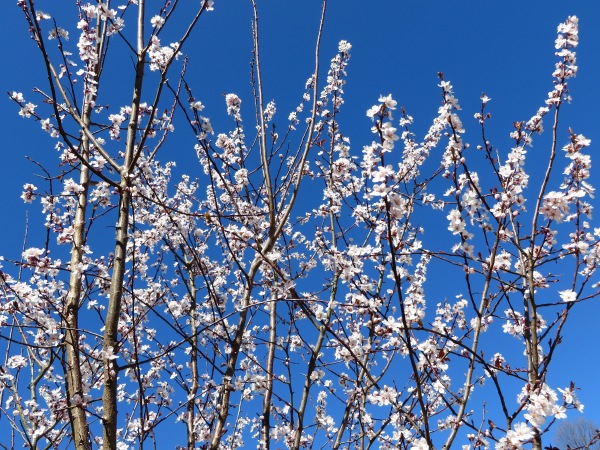
A lovely surprise greeted Matt and me at our York home:
the plum tree is already blooming! March 5, 2017
“I am living on hope and faith…a pretty good diet when the mind will receive them.”
— Edwin Arlington Robinson
It’s interesting that a poet of Robinson’s stature, who penned the devastatingly powerful “Richard Cory,” would describe himself as living on hope and faith. Such somber work does not seem consistent with what we think of as a positive attitude. Yet, by their very nature, hope and faith are not as obviously necessary for survival when all is going well. It is only when the full weight of human frailty and mortality comes crashing in that we realize our souls’ crucial need for belief in something higher than we can now comprehend.
I have been living on hope and faith for many years, and never more than during the past four. Cynical voices (including the one in my own head that I can never quite shut out) might rightly ask: so you have, and where did this get you? Were not your hopes disappointed, even crushed? Yes, they were cruelly dashed, time and again. But faith and hope are not wishing wells where simple petitions are met with guaranteed fulfillment. Rather, they are dynamic, growing forces that reveal layer after layer of hard-won understanding. As Robinson attests, they provide solid nourishment for the soul, when the mind will receive them.
My mind won’t always cooperate with such a diet. Like a child who turns away from vegetables regardless of how many times the grown-ups talk about how good they are, I often handle my pain with binges of anger, resentment, self-pity and hopelessness. And the cynic’s question is equally valid here: where do these take me? Not to any place I want to be for very long. Faith and hope are, in many ways, their own rewards, conferring benefits not dependent on immediate fulfillment.
So how do we discipline our minds to receive this “pretty good diet?” What visual, auditory and tactile input goes into your own recipe for pressing on through tough times? What tastes or aromas bring instant relief from stress? Sometimes, an unexpected and surprisingly small joy can snap me out of a dismal attitude. My first sight of our early-blooming plum tree was one such delight that helped me through this weekend. What works best for you?
This post was first published seven years ago today. The original post, comments and photo are linked, along with two other related posts, below. These links to related posts, and their thumbnail photos, do not appear in the blog feed; they are only visible when viewing the individual posts by clicking on each one. I have no idea why, nor do I know how they choose the related posts. That’s just the way WordPress does things.
To wander
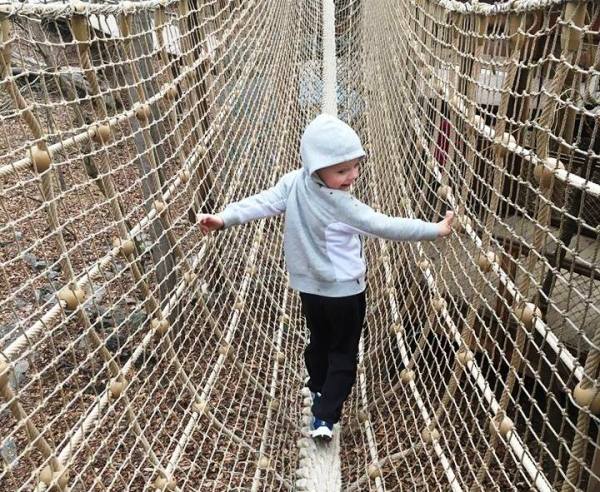
Grady was far ahead of me when I zoomed in for this shot. Atlanta, December 2016 ERROR! I did NOT take this photo– I stole it off Megan’s Facebook page — but it was an honest mix-up because I put it in the same computer folder. See below for some I did take that day.
Same place, different day; this one was made in January, 2017. SORRY!
“Wandering is the activity of the child, the passion of the genius; it is the discovery of the self, the discovery of the outside world, and the learning of how the self is both ‘at one with’ and ‘separate from’ the outside world. These discoveries are as fundamental to the soul as ‘learning to survive’ is fundamental to the body…To wander is to be alive.”
― Roman Payne
One of the pastimes of childhood that too often vanishes into the busyness of adulthood is this practice of wandering. Kids are naturally good at it, although I think contemporary and quite valid concerns for safety have curtailed the scope and freedom we enjoyed when we were very young. But perhaps I’m only imagining that we had a wider world open to us, when in reality, it was almost as carefully circumscribed by watchful parents and caregivers as it is today, and I was simply unaware of it because of their ability to keep those limits hidden.
For Christmas, Drew and Megan requested a family membership to the wonderful Fernbank Museum of Natural History, and we spent an unseasonably sunny and warm Christmas Eve there. When we went outside to the WildWoods, Grady took off to explore well ahead of us, and there’s no doubt his imagination took him worlds away as he navigated the fascinating features of the outdoor trails. Of course, he never left our sight, but in his mind I’m sure he might as well have been alone– with the added benefit of a comforting certainty that we would be there if he needed us. Watching him from a distance was almost as good as being a child again myself, remembering the delight in discovering so many things for the very first time.
When was the last time you went wandering? I encourage you to find time for it. If the weather and your health will permit it, wander around outdoors, perhaps visiting a park or garden. But if you are unable to get outside anytime soon, you can let your mind wander by visiting any library, or browsing your own well-loved collection of favorite books. The passion of the genius, as Payne implies, really does start out as the activity of the child. And perhaps we all still have a bit of the child– and the genius– somewhere inside us.
Editorial correction: I was just going through my photos and realized that I mixed up two different days of photos taken of Grady at the WildWoods trail. The one above was actually taken by Megan on a subsequent trip in January, 2017. As the photos below from the December 2016 trip that I wrote about here show, Grady (in a different outfit but just as adventurous) DID stay ahead of us then, too, both inside and out.
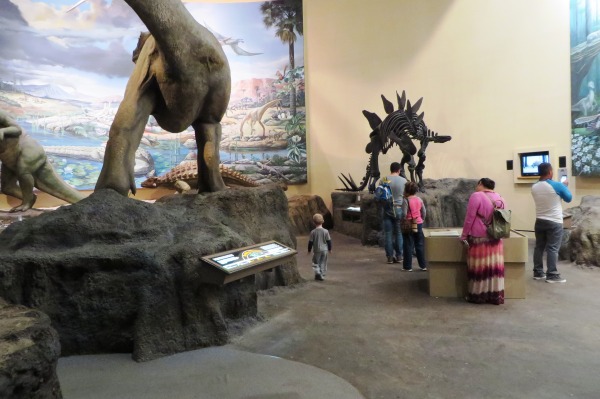
Grady took off ahead of us in the museum, too, even before we were outdoors.
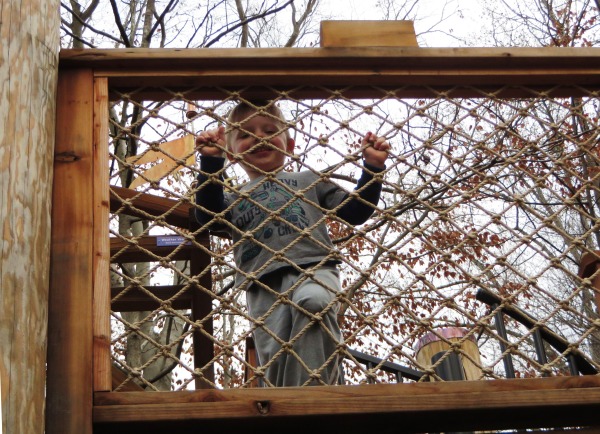
Here’s one I actually did take that Christmas Eve, 2016.
Since 2024 is a leap year, the posts from seven years ago will now revert to the Wednesday/Saturday schedule as before, beginning today.
This post was first published seven years ago today. The original post, comments and photo are linked, along with two other related posts, below. These links to related posts, and their thumbnail photos, do not appear in the blog feed; they are only visible when viewing the individual posts by clicking on each one. I have no idea why, nor do I know how they choose the related posts. That’s just the way WordPress does things.
These wishes
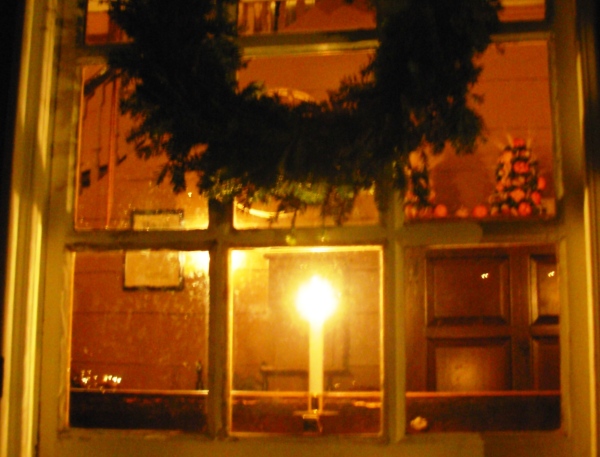
A candle-lamp shines through a window in Colonial Williamsburg, December 2008.
“I wish you, I wish you,
I wish you these wishes:
Cool drinks in your glasses
Warm food in your dishes.
People to nourish and cherish and love you.
A lamp in the window to light your way home in the haze.
I wish you the sweetest of nights
And the finest of days.” — Judith Viorst
Most of the people I know are familiar with Viorst’s classic picture book about young Alexander and his terrible, horrible, no good, very bad day. I join millions of readers who are fans of this book, but there are books she has written for adults that I like just as well, or maybe better.
The little rhyme above is taken from her book Suddenly Sixty and Other Shocks of Later Life. Some of the poems in this collection are not relevant to me, but most of them are; some are strikingly so. Viorst has a talent for combining the poignant ups and downs of life with a remarkable ability to find humor in almost any situation. It is immensely comforting to read her words and know that much of what we face in life is fairly universal. Her work glows with reassuring familiarity as she writes of the highly personal with confidence that her readers will understand and sympathize.
The words quoted today are from a poem subtitled “A song for our children and our children’s children.” But when I read them, I think mostly of the adult people I know right now: the friends I cherish, the family I will always love dearly, and the many faithful, fascinating and fabulous readers of this blog. I wish you all the lovely things Viorst mentions, and many more. Thanks for being here!
This post was first published seven years ago today. The original post, comments and photo are linked, along with two other related posts, below. These links to related posts, and their thumbnail photos, do not appear in the blog feed; they are only visible when viewing the individual posts by clicking on each one. I have no idea why, nor do I know how they choose the related posts. That’s just the way WordPress does things.
Close at hand
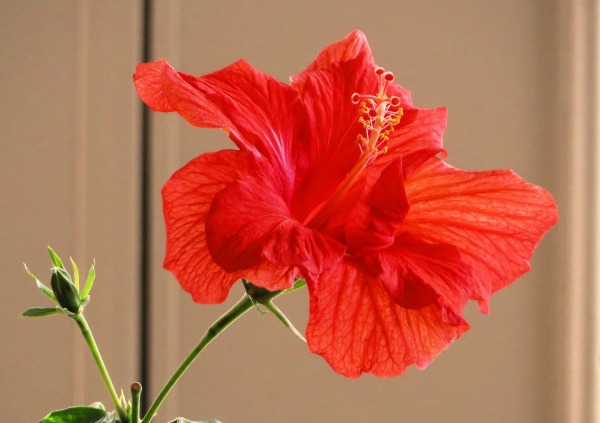
A single beautiful bloom brightened my day, February 2017.
“Survival starts by paying attention to what is close at hand and immediate. To look out with idle hope is tantamount to dreaming one’s life away.” ― Yann Martel
Last summer I bought a small hibiscus plant at a clearance price, and brought it home to our deck. It thrived and bloomed profusely, until I noticed the upper leaves were beginning to disappear. It didn’t take long before I discovered the culprit: a squirrel who decided to dine on it several times a day. I got quite a few photos of that squirrel eating up our lovely plant before I chased him away, but he kept returning no matter how cleverly I placed the plant hoping to shield it from his hungry paws and jaws.
In the fall, as the weather began to turn and I was coping with the shock of deep grief, I brought the now-straggly plant indoors, hoping to preserve it for the winter. All but one of the stripped stalks eventual shriveled and died, but there was one that did not, and continued to bear leaves that the squirrel could no longer consume. With the recent warm days we have enjoyed, I took it outside for a few days, and soon it produced a single beautiful bloom.
As with all hibiscus flowers, it faded quickly, but not (as you probably would guess) before I took several photos of it, marveling at how it looked so different from various angles and lighting. It was a lovely start to an otherwise difficult day. Will that single stalk survive? Will others take the place of the ones that died? Stay tuned; updates are sure to follow.
In the meantime, though, I thought of that flower when I read what Martel said about survival. It is a concise but very accurate summary of what has kept me going. That bloom was close at hand, and immediate, as are so many other things that have filled the days and weeks that otherwise may have been unbearable.
Much of the immediate is not particularly appealing; bureaucratic nonsense related to various aspects of Matt’s disability services, seemingly endless paperwork following Jeff’s death, which comes from the Defense Finance and Accounting, the Veteran’s Administration, the Social Security Administration and numerous other contacts; and all the laundry, care-giving and household maintenance that I am now handling alone. Survival has required that I pay attention to these things, and whether I like it or not, it probably has been a sort of distraction from deep sorrow.
But I’m especially thankful for all the lovely things that are close at hand. Matt’s generally agreeable nature, Amy’s continual support, the morning mug of tea (and the second morning one, and the mid-morning one, and the noontime one, and the early afternoon, and…) and the continuing joy of books, birds and blooms– these are only a few of the things that are there, awaiting my attention, enabling my survival.
What is close at hand and immediate for you today? Whether these things inspire curses or blessings, your attention to them will get you through the day. I wish you many joys that are this very moment within easy reach.
This post was first published seven years ago today. The original post, comments and photo are linked, along with two other related posts, below. These links to related posts, and their thumbnail photos, do not appear in the blog feed; they are only visible when viewing the individual posts by clicking on each one. I have no idea why, nor do I know how they choose the related posts. That’s just the way WordPress does things.
No small gift
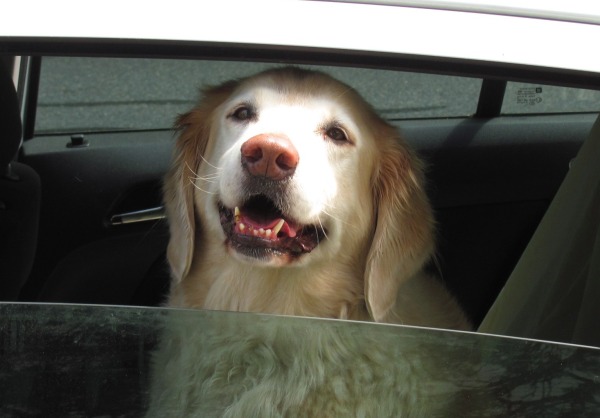
Happy dog in Eastham, Massachusetts, by John Phelan via Wikimedia Commons
“Because of the dog’s joyfulness, our own is increased. It is no small gift. It is not the least reason why we should honor as well as love the dog of our own life, and the dog down the street, and all the dogs not yet born.” — Mary Oliver
My life is not yet ready to adopt another dog into our home, but that does not prevent me from enjoying every encounter, however brief, with these delightful creatures. For me, dogs are therapeutic, providing instant joy. I am so grateful they are part of our world. Please give my personal thanks to the next one you see.
This post was first published seven years ago today. The original post, comments and photo are linked, along with two other related posts, below. These links to related posts, and their thumbnail photos, do not appear in the blog feed; they are only visible when viewing the individual posts by clicking on each one. I have no idea why, nor do I know how they choose the related posts. That’s just the way WordPress does things.
A never-tiring affection

Renee, Mitzie, Troy and Myra at my birthday celebration, 2018
“One by one, as they march, our comrades vanish from our sight, seized by the silent orders of omnipotent Death. Very brief is the time in which we can help them, in which their happiness or misery is decided. Be it ours to shed sunshine on their path, to lighten their sorrows by the balm of sympathy, to give them the pure joy of a never-tiring affection, to strengthen failing courage, to instill faith in times of despair.”
― Bertrand Russell
Those who have been reading this blog for at least a couple of years may recognize that quote, which I’ve used once before. It has been my practice never to use the same quote twice, but today I broke that rule because the quote is so perfect for what I wanted to describe.
You probably also will recognize the three women with me in the photo above. (The lone man is Myra’s son Troy, one of the most cheerful people you will ever meet.) For the third year in a row, Renee, Mitzie and Myra made sure I was not alone for my birthday, which was also Jeff’s birthday.
As always, they showered me with lovely gifts and even lovelier sentiments in the cards they brought me. This year, there was also a special treat in the form of the little birthday “fireworks display” that was brought to our table at the Asian restaurant where we had dinner. I had never seen such a thing before.

It appeared to be a closed lotus flower atop a piece of cake, but when the server lit it, it became sort of a volcano with a flame that shot upward. Then the lotus petals slowly opened outward, each bearing a tiny lit candle, with an embedded music box playing the Happy Birthday song. I wish I’d had my camera to take a video of the whole thing, but Myra caught a photo of how it looked at the end. It was so much fun!
There are many traits we value in our friends: humor, understanding, loyalty and a spirit of fun are among them. But as I grow older, the trait that seems most important of all is the willingness to maintain a steadfast presence in our lives. It’s not always easy to commit time to friends, particularly through years of trials and sorrows. But these women have stayed with me every step of the way.
Through darkest grief, across significant geographical distance, and despite their own full time careers, family demands and dedication to church and community service, my special sisters have gone the distance with me, both literally and figuratively, for many years now. The quote from Russell that appears above could have been written about them. They have given me all the gifts he describes, with the crowning one being “the pure joy of a never-tiring affection.”
My wish for each of us is that we learn to give, and receive, this precious gift.

That’s us on my birthday at the Puakea home in 2017.
Don’t you love their funny Christmas sign?
This post was first published seven years ago today. Though much has changed during those years, these three phenomenal women remain a constant presence in my life, despite my having, in 2021, sold the York home so close by their homes, and despite my being a less-than-stellar correspondent who often relies on them being the ones to get in touch with me (thanks for your patience, ladies). This year, as in all the years past, they made sure I did not celebrate my birthday alone. Their unwavering support and understanding continue to be a blessing beyond description.
The original post, comments and photo are linked, along with two other related posts, below. These links to related posts, and their thumbnail photos, do not appear in the blog feed; they are only visible when viewing the individual posts by clicking on each one. I have no idea why, nor do I know how they choose the related posts. That’s just the way WordPress does things.


 Defeat Despair